Fast Car Recovery Near Me: What to Expect
Last Updated: November 2, 2026
Quick Summary
Fast car recovery near me is a 24/7 emergency service that gets a trained operator to your broken-down vehicle quickly, then recovers it safely to a garage or destination of your choice. Gales Recovery commits to a 45-minute response time across our service area. Response time is measured from the moment you call to the moment a trained technician reaches your vehicle, not from the moment you book.
Car recovery cost depends on distance, vehicle size and weight, time and day, condition, and access.
Ask whether the quoted price is final and what would change it before confirming any booking.
On a motorway, get behind the barrier and stay there, and never place a warning triangle.
Give the operator the road number, nearest junction or landmark, and your direction of travel.
Have your policy number, vehicle registration, and insurer's claims line ready for direct billing.
Table of Contents
What Fast Car Recovery Near Me Actually Means
Fast car recovery near me is a 24/7 emergency service that gets a trained operator to your broken-down vehicle quickly, then recovers it safely to a garage or destination of your choice. Gales Recovery commits to a 45-minute response time across our service area. Most people search for this term while standing on a verge with hazard lights flashing, so the answer needs to be practical, not a sales pitch. Below, we explain exactly what drives response times, what affects the cost, and what to do in the first ten minutes of a breakdown.
The uncomfortable truth is that "near me" is doing a lot of work in that search. A provider forty minutes away is not near you. A provider who says "twenty minutes" on the phone and arrives in two hours is worse than one who tells you the truth.
So here is the definition that matters: fast car recovery is a service measured from the moment you call to the moment a trained technician reaches your vehicle, not from the moment you book. Everything in this guide follows from that.
Car Recovery Response Time: What to Expect
Gales Recovery commits to a 45-minute response time. Traffic, weather, and the type of vehicle can all affect how quickly a recovery operator reaches you, and the operator can tell you which factors are at play on your call.
Why a 45-Minute Commitment Matters
A committed response time matters because it means the operator has to plan coverage, not just answer phones. When you are stranded, the difference between 45 minutes and two hours is not convenience. It is whether you miss a shift, a hospital appointment, or a school pickup.
If you want the fuller detail on what shapes arrival times, read our guide to emergency roadside assistance response times.
Rural Postcodes and Finding You
Rural postcodes are the hardest part of any recovery job. Sat nav often drops the pin at the wrong gate, and a farm track with no name is not a location, it is a guess. When you call, give the operator three things: the road number, the nearest junction or landmark, and your direction of travel.
Landmarks can help when postcodes do not identify a rural location. For a deeper walkthrough, see our guidance on emergency recovery on rural roads.
Car Recovery Cost: What Affects the Price
Car recovery cost depends on several factors, and the final price should be confirmed with the operator before a vehicle is dispatched.
The main factors:
Distance from your location to the destination garage, measured in loaded miles rather than straight-line miles
Vehicle size and weight, including vans, fleet vehicles, and anything over 3.5 tonnes that needs a larger flatbed
Time and day, since out-of-hours call-outs carry different costs and bank holidays are usually priced as out-of-hours
Condition, because a collision-damaged car needs more handling, winching, or skates than a flat battery
Access, since a locked car park, narrow lane, or low barrier takes longer and may need a smaller vehicle first
When you get a quote, ask the operator to explain how the figure is made up and what it includes. A clear answer is a good sign.
No Hidden Fees and Transparent Pricing
Transparent pricing means the number you agree on the phone is the number you pay, with no add-ons invented at the roadside.
A common mistake is choosing the cheapest quote without asking what it excludes. Our guide to avoiding hidden recovery fees covers the questions that expose surprise charges before you commit.
Watch out: a quote that is dramatically lower than every other quote usually means the mileage or handling charge has been left out and will be added at the roadside.
Direct Insurance Billing Explained
Direct insurance billing means the recovery company invoices your insurer directly, so you are not paying upfront and chasing reimbursement later. For a step-by-step walkthrough, see how direct insurance billing works. You still need to confirm your policy covers recovery, and you still need your policy number ready.
Contact Gales Recovery to confirm how direct billing applies to your policy before the vehicle is dispatched.
Emergency Breakdown Recovery on Motorways and A-Roads
Emergency breakdown recovery on motorways follows one rule above all others: get behind the barrier and stay there. On a smart motorway, the red X means the lane is closed, and it is closed for you (Red X).
The sequence that keeps you safest is:
Pull onto the hard shoulder or into an emergency refuge area if one is within reach, and switch on hazard lights
If you cannot reach a refuge area, stop in the left lane only as a last resort and leave the vehicle immediately
Get everyone out on the passenger side, away from traffic, and behind the barrier
Leave animals in the vehicle unless it is unsafe to do so
Call for recovery and give the motorway number, direction of travel, and the last marker post or junction you passed
On A-roads, pull as far off the carriageway as you can, switch on hazard lights, and put a warning triangle out only if it is safe to walk. Never place a triangle on a motorway.
Watch out: walking back along a motorway to find a marker post is one of the most dangerous things a stranded driver can do. Give the operator your approximate location instead and let them find you.
Accident Recovery and Damaged Vehicles
Accident recovery handles vehicles that cannot be driven because of collision damage, not just mechanical failure. That means flatbed transport, secure winching, and careful loading to avoid further damage. Gales Recovery offers accident recovery for damaged vehicles that cannot be driven.
If the police have attended, ask them whether the vehicle can be moved and whether the road needs clearing first.
Vehicle Transportation and Flatbed Towing
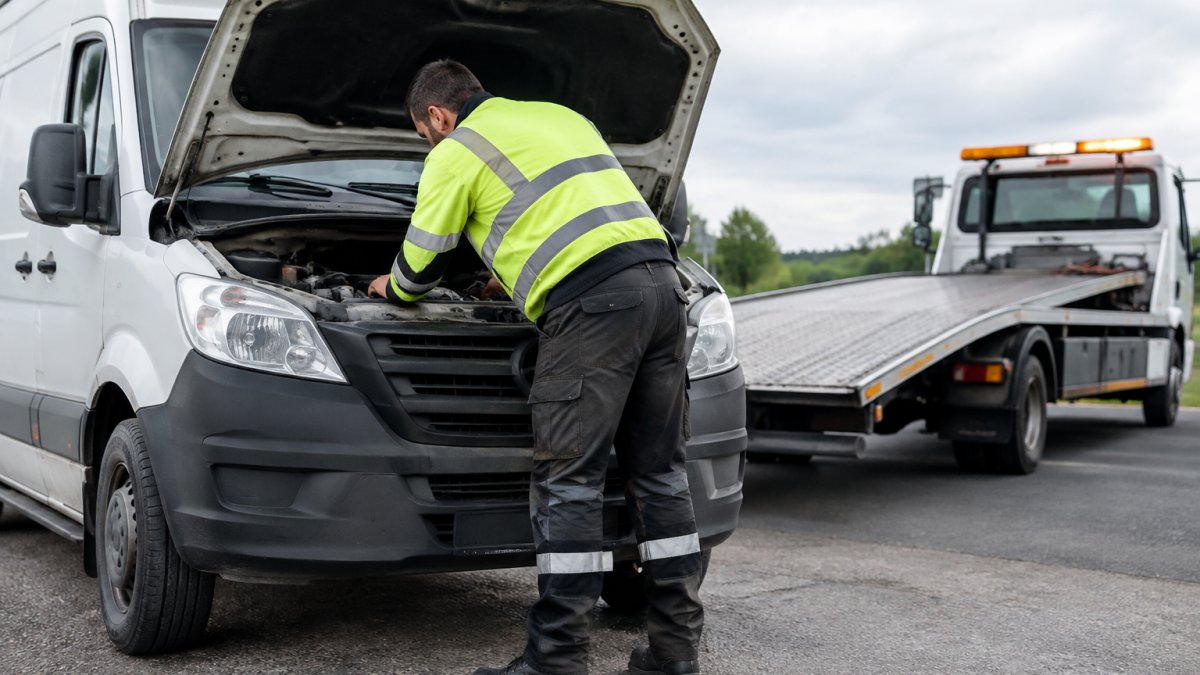
A flatbed keeps all four wheels off the road, which can be the more suitable method for some vehicles, such as all-wheel-drive cars or automatics that should not be towed with wheels down.
If your vehicle is all-wheel-drive, four-wheel-drive, or has an automatic gearbox, ask the operator about the most suitable towing method before you confirm the booking.
Roadside Assistance at Home and On-Site Repair
Breakdowns can also happen at home, on a driveway, for example.
Jump Start and Battery Service
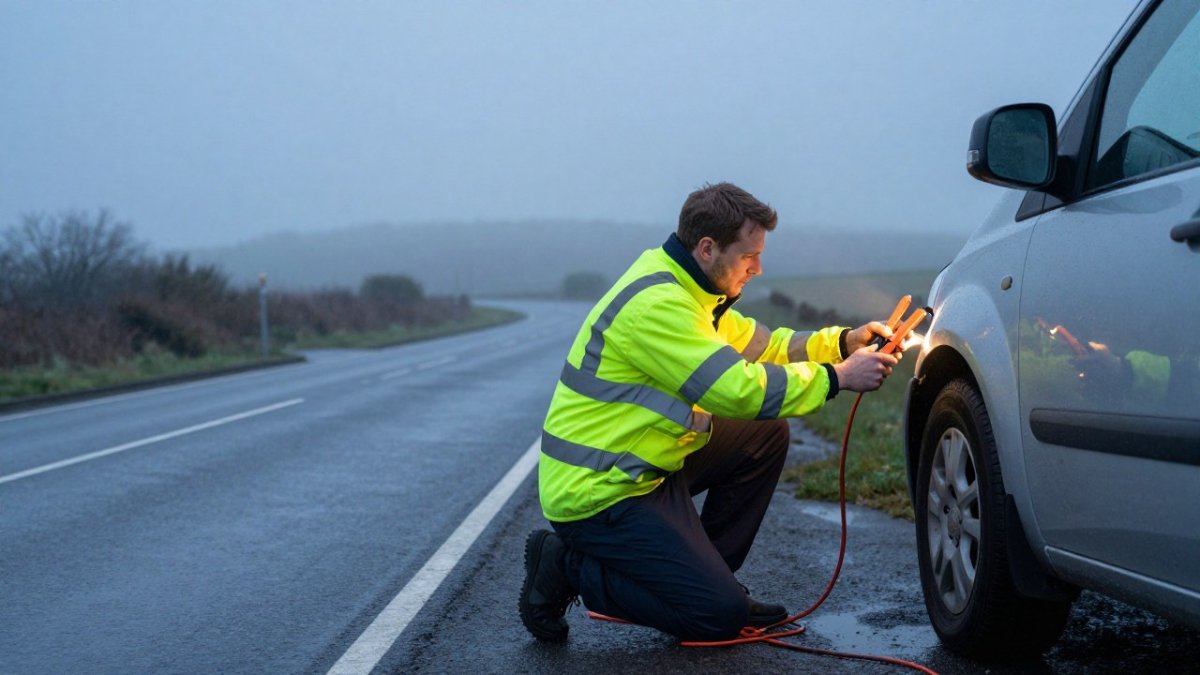
A jump start can get a car moving when the battery is flat. A battery test can show whether the battery is still holding charge. A common mistake is jump-starting a failing battery repeatedly instead of replacing it, which leaves you stranded again a week later. If the battery is more than a few years old, ask for a test, not just a boost.
Recovery vs Roadside Repair: Which Do You Need?
Recovery versus roadside repair comes down to one question: can the fault be fixed safely at the roadside? Some minor faults can be handled at the roadside, while others require the vehicle to be taken to a garage.
Situation | Best Option | Why |
Flat battery | Jump start or battery service | Fixed on-site in minutes |
Flat tyre with spare | Roadside repair | Quick change, no tow needed |
Damaged wheel or suspension | Recovery to garage | Unsafe to drive |
Non-starting engine | Diagnosis, then recovery if needed | Fault may need workshop tools |
Collision damage | Accident recovery | Vehicle not roadworthy |
What to Do While You Wait for Recovery
What you do while waiting for recovery matters more than most drivers realise. The first ten minutes set up the next hour, and a few simple actions keep you and your passengers safe while the truck is on its way.

Work through this checklist:
Pull as far off the carriageway as you can and switch on hazard lights
Get everyone out on the safe side, behind the barrier where there is one
Put on a high-visibility jacket if you have one
Note your location precisely, including direction of travel
Call for recovery and stay on the line for any safety instructions
Keep away from the traffic side of the vehicle at all times
Safety Protocols During a Roadside Breakdown
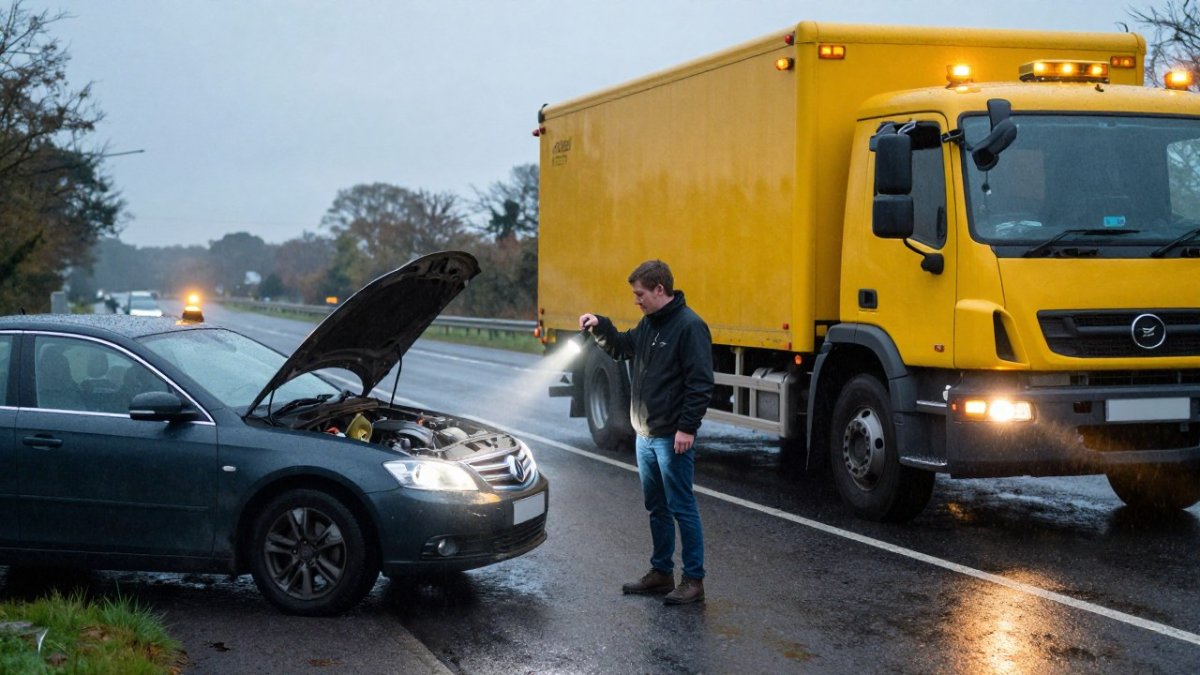
Safety protocols during a roadside breakdown start with one rule: never stand between your vehicle and moving traffic. A stranded car is a hazard, and a person beside it is a bigger one. In poor light or rain, stay in the vehicle with seatbelts on if you cannot reach a barrier safely, and call for help.
Watch out: walking back along a motorway to find a marker post is one of the most dangerous things a stranded driver can do. Give the operator your approximate location instead and let them find you.
Insurance and Documentation to Have Ready
Insurance and documentation speed up recovery, especially if you want direct billing. Have your policy number, the vehicle registration, and your insurer's claims line to hand. If you have breakdown cover, know whether it is a standalone policy or an add-on, because the claims route differs.
Call Gales Recovery for Fast Car Recovery
When your car will not move, the priority is a trained operator who arrives when they say they will. Gales Recovery runs 24/7 with a 45-minute response commitment and direct billing to insurers. Gales Recovery also offers event services, including road clearance.
You can arrange vehicle recovery and get a clear quote before we dispatch.
Frequently Asked Questions
How quickly can a car recovery service reach me?
Response time depends on your location and how busy the roads are. Gales Recovery commits to a 45-minute response time across West Sussex, East Sussex, Surrey and Hampshire. When you call, give your exact location, including the postcode, road number and direction of travel, plus any landmarks. On motorways and A-roads such as the M3, A34 or A27, that detail helps the driver reach you without circling. If you are in a rural spot, stay on the line so the team can confirm the nearest access point.
How much is car recovery and what affects the price?
Car recovery cost depends on several factors: the distance to your destination, the type of vehicle, whether it is a breakdown or accident recovery, the time of day, and whether a flatbed is needed. Prices vary between providers, so ask for a free quote before booking and confirm what is included. Gales Recovery can bill your insurer directly where your policy covers recovery, so you are not chasing reimbursement afterwards.
Can I get roadside assistance at home rather than on a road?
Yes. Roadside assistance at home covers breakdowns on your driveway or outside your house, not just on public roads. If the vehicle cannot be fixed at the roadside, it can be recovered to a garage. Contact Gales Recovery to confirm what is available for your situation.
Does car recovery include roadside repairs, and can you take my car to my chosen garage?
Emergency breakdown recovery can help get you and your vehicle to safety. Tell the operator which garage you want when you book so the destination can be confirmed upfront.
A breakdown tests your patience and your safety at the same time. Gales Recovery answers both with 24/7 availability, a 45-minute response commitment, direct insurance billing, and professional handling of everything from a flat battery to a collision-damaged van. Get started with Gales Recovery and get moving again with one call.
Comments