Van Recovery for Fleet Vehicles: A Fleet Manager's Guide
Last Updated: October 30, 2026
Quick Summary
Van recovery for fleet vehicles is the process of recovering a stranded commercial van with a plan that accounts for weight, load, access and the cost of downtime, not just moving the vehicle. A workable fleet plan names who the driver calls first, who authorises recovery and up to what limit, and what the driver records. Check the contractual response target, callout allowance and exclusions in writing before you sign fleet breakdown cover.
A panel van carrying tools, stock or equipment weighs more than its kerb weight, which affects how it can be lifted, towed and transported.
A fleet breakdown response plan should fit on one page and be tested with a dry run before it is needed.
Multi-vehicle fleet cover usually lowers the per-vehicle cost but often carries a fleet-wide callout allowance rather than an unlimited one.
Long-wheelbase and Luton vans often need a flatbed rather than a suspended tow, and a Luton with a tail lift adds weight.
Review vehicles that break down twice within a rolling three-month period, because the second failure is usually predictable.
Table of Contents
Why Van Recovery for Fleet Vehicles Is a Different Job
A van on a recovery truck is not the same problem as a hatchback on a recovery truck. Van recovery for fleet vehicles has to account for weight, load, access and the cost of every hour the vehicle sits still.
Most breakdown guides are written for private motorists. They assume one driver, one journey and no commercial consequence. Fleet managers can't work that way.
What Changes When a Van Carries Your Business
The first change is what's inside the van.
The second change is the knock-on effect. According to GOV.UK guidance on commercial vehicle roadworthiness, keeping commercial vehicles roadworthy is a legal duty, not just good practice.
The third change is the paperwork. Fleet recovery involves a fleet account, an agreed recovery policy and a clear breakdown incident record.
Building a Fleet Breakdown Response Plan That Works on the Day
A fleet breakdown response plan is a written procedure that tells every driver exactly what to do, and who to call, when a commercial vehicle stops moving. The best plans fit on one page.
Here's what a workable plan covers:
Who the driver calls first (and the backup number if the first call doesn't connect)
What the driver must not do (attempt repairs on a live carriageway, for example)
Where the vehicle should be moved to if it can be driven slowly to a safe place
The plan should be tested before it's needed. A dry run with a single vehicle exposes the gaps that a written document hides.
The Incident Workflow: From Driver Call to Vehicle Back in Service
A typical incident workflow follows a simple sequence, and drivers can follow it too.
Driver calls in with location, vehicle registration and a description of the fault.
Operator confirms safety and tells the driver to move clear of traffic.
Recovery is dispatched with the right vehicle for the van's size and load.
On-site assessment determines whether the van can be repaired at the roadside or needs transport.
Vehicle is recovered to a repairer, depot or safe holding location.
Fleet manager is updated with time, location and next steps.
Incident is logged for cost tracking and pattern spotting.
For a step-by-step walkthrough of booking recovery online, see how to book emergency vehicle recovery online.
A typical incident workflow follows a simple sequence that drivers can follow too.
Step | What happens |
1 | Driver calls in with location, registration and fault description |
2 | Operator confirms safety and tells driver to move clear |
3 | Recovery dispatched with right vehicle for van size and load |
4 | On-site assessment decides roadside repair or transport |
5 | Vehicle recovered to repairer, depot or safe holding location |
6 | Fleet manager updated with time, location and next steps |
7 | Incident logged for cost tracking and pattern spotting |
Fleet Breakdown Cover: What to Check Before You Sign
Fleet breakdown cover is a policy or account arrangement that covers multiple commercial vehicles under one agreement, usually with defined response commitments and billing terms. The detail matters more than the headline, because two quotes that look similar on page one can behave very differently on a wet Tuesday in February.
Single-Vehicle Versus Multi-Vehicle Cover
A single-vehicle policy suits a business running one or two vans. Multi-vehicle fleet cover pools the risk across the fleet, which usually lowers the per-vehicle cost and simplifies administration. The trade-off is that fleet policies often carry a fleet-wide callout allowance rather than an unlimited one, so a bad quarter can eat into the cover that protects you later in the year.
Service-Level Agreements and Response Targets
A service-level agreement (SLA) is the part of the contract that states what the provider commits to, how it is measured, and what happens when it is missed. A stated response target is not the same as a guarantee, so read the wording carefully. Look for:
Response-time definition, is it time to arrival at the roadside, or time to dispatch?
Measurement method, is the clock stopped for traffic, weather or access delays?
Escalation path, who do you call when the target is missed, and what authority do they have?
A common pattern is for providers to publish an average response time but contract to a much softer target. Ask for the contractual figure in writing, not the marketing figure.
Pricing Models: Per-Vehicle, Fleet-Wide and Callout Fees
Fleet recovery pricing usually follows one of three models:
Per-vehicle cover, a fixed annual premium for each van, with callouts included up to a limit.
Fleet-wide cover, a single premium based on fleet size, vehicle types and claims history.
Pay-per-callout, no annual premium, but a charge every time a vehicle is recovered, often at a discounted fleet rate.
Whichever model applies, check the charges that sit outside it: callout fees, per-mile charges beyond an included radius, out-of-hours and weekend rates, storage charges, and cancellation terms if the driver gets the van going before the recovery vehicle arrives. A quote that ignores these variables is not a quote you can budget against.
Vehicle Eligibility and Exclusions
Standard fleet cover is often written around light commercial vehicles up to a certain weight. Larger vans, Lutons with tail lifts, vehicles with roof racks or tow bars, and vans carrying hazardous or high-value loads may fall outside standard terms. Check the limits for vehicle size, gross weight, age, modifications, trailers and payload before you sign, and confirm the geographic coverage, some policies cover the whole of the UK but exclude certain islands or require a separate arrangement for cross-border journeys.
Billing and Direct Insurance Billing
Direct insurance billing means the recovery operator invoices the insurer rather than asking you to pay upfront and chase reimbursement. For a fleet, that removes the cash-flow problem and the administrative burden of reclaiming costs across dozens of incidents a year. Our guide to how direct insurance billing works explains the process step by step.
Key Takeaway Before signing any fleet breakdown cover, ask for the contractual response target, the callout allowance, the per-mile rate beyond the included radius, and the full exclusions list in writing. If a provider will not put those in the contract, treat the headline price as indicative only.
Van Breakdown Recovery: Vehicle Types, Access and On-Site Limits
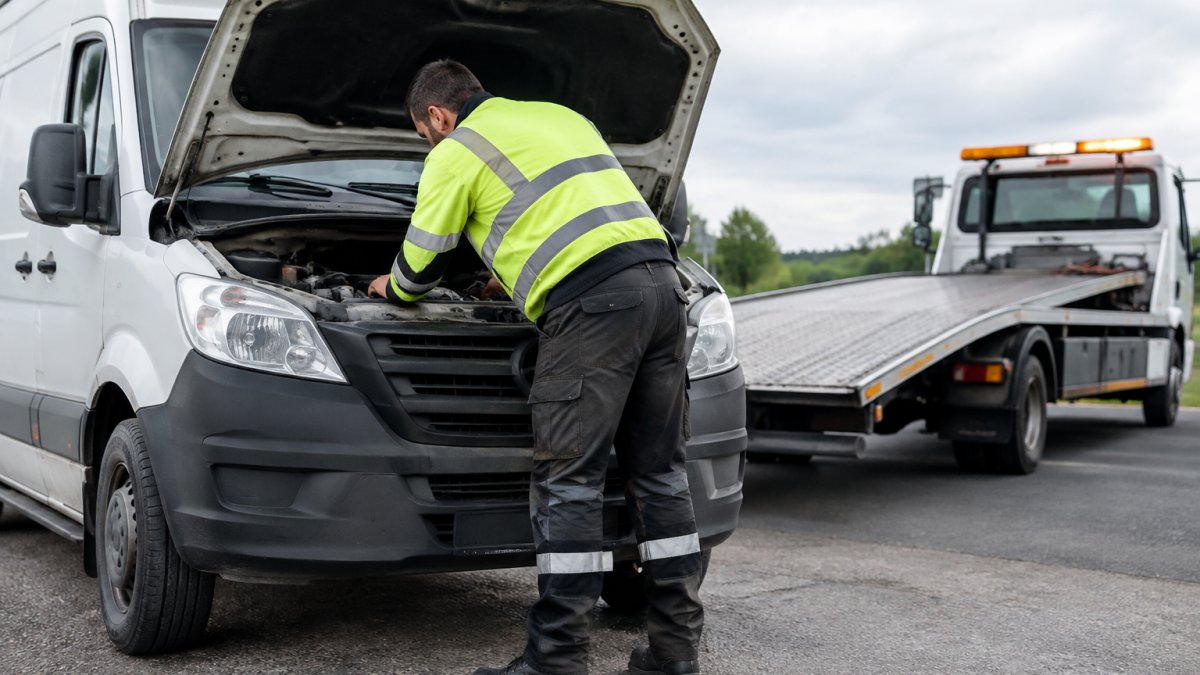
Van breakdown recovery is the roadside and transport side of the job: getting a stranded commercial van to a safe place or a repairer without further damage. Not every recovery truck suits every van.

Panel Vans, Lutons and Long-Wheelbase Models
A short-wheelbase van is the easiest case. It fits standard recovery equipment and can usually be moved quickly.
A long-wheelbase van or Luton van is a different proposition.
Access is the other limit. Narrow residential streets, low barriers, multi-storey car parks and loading bays with tight turns can all stop a recovery vehicle reaching a stranded van.
Fleet Vehicle Downtime Management and Business Continuity
Fleet vehicle downtime management is the practice of reducing the time a vehicle spends off the road and planning what happens to the work in the meantime. Recovery is one part of it. Replacement capacity and load transfer are the other, and they are where most fleet plans fall short.
Replacement Vehicles and Onward Transport
When a van is recovered, the load often matters more than the vehicle. Ask your recovery provider whether they can arrange a replacement van, onward transport for the load, or a transfer to a nearby depot.
Load Transfer and Secure Storage
If the van cannot be repaired on site, the load has to go somewhere. Options include transferring it to another fleet vehicle, moving it to a depot, or storing it securely until it can be collected. Confirm in advance whether your provider offers secure storage, and whether the load is insured while it is held. A van full of tools or stock sitting on a recovery yard is a business risk as well as a cost.
A Practical Business-Continuity Checklist
A workable continuity plan fits on one page and answers these questions:
Which vehicles are critical? Identify the vans whose loss stops work immediately.
Who authorises a replacement? Set a spending limit so drivers are not waiting for approval.
Where does the load go? Name the depot, the contact and the transfer method.
Using Downtime Data to Prevent Repeat Failures
Record every downtime event with start and end times, the fault, the vehicle and the driver. Over a quarter, patterns emerge: a van that fails twice in a short period is usually telling you something about maintenance, loading or driver behaviour. Feed those patterns into your maintenance schedule and inspection routine. Recovery is the response; the data is how you reduce the number of responses you need next year.
Pro Tip Review vehicles that break down twice within a rolling three-month period. The second failure is usually predictable, and catching it before the third callout is where downtime management pays for itself.
Costs, Exclusions and How to Read a Recovery Quote
Recovery pricing depends on distance, vehicle size, time of day, load and whether the vehicle can be repaired on site. For current prices or a quote, contact Gales Recovery directly.
When you read a recovery quote, look for:
Callout charge versus per-mile charge (and whether the first miles are included)
Vehicle size bands and where your vans fall
Load surcharges for heavy or awkward cargo
Watch out: the cheapest headline quote often excludes the charges that actually apply. Ask for a written breakdown of every charge before you commit, and check what happens if the recovery takes longer than expected. Our guide to avoiding hidden recovery fees covers the questions worth asking.
Choosing a Recovery Partner for Your Fleet
Choosing a recovery partner comes down to four things: coverage, response, billing and communication. Everything else is detail.
Coverage means the operator can reach every route your vans use, not just the motorway network.
Response means a stated commitment you can hold them to.
Billing means the invoicing works with your accounts process, and direct insurance billing removes the upfront payment problem entirely.
Communication means you get updates during the incident, not after it.
For fleet managers who want a single point of contact for breakdown recovery, roadside assistance and accident recovery, our recovery services cover the full job, including 24/7 availability and direct billing to insurers.
If you need realistic expectations for how quickly a recovery team can reach a stranded van, read our guide to emergency roadside assistance response times before you set your own internal targets.
Frequently Asked Questions
What should a van fleet breakdown recovery service include?
At minimum: 24/7 call handling, a stated response time, recovery of the vehicle rather than just a jump start, and transport to a garage or depot of your choosing. For fleets, add multiple callout capacity, a named account contact, and clear exclusions for vehicle size and weight. Ask whether roadside repairs are attempted first and whether direct insurance billing is available, so drivers are not paying out of pocket at the roadside.
How quickly can a recovery vehicle reach a broken-down van?
Response time depends on location, time of day and provider capacity, so ask for a commitment in writing rather than a verbal estimate. Gales Recovery commits to a 45-minute response time. Rural and motorway locations can stretch that, so give the call handler a precise location, a what3words reference or junction marker, and a callback number for the driver.
Can a recovery provider assist with multiple fleet vehicles at once?
A single incident usually involves one vehicle, but fleets need to know what happens when several vans are stranded at once, for example after a depot incident or severe weather. Ask your provider how many simultaneous callouts they can handle, whether priority is given to account customers, and whether they work with partner operators for overflow. Put that answer in your fleet breakdown response plan so nobody is guessing at 6am.
How can fleet managers reduce vehicle downtime after a breakdown?
Plan the recovery before you need it: store driver details, vehicle registrations and preferred repairers in one place, agree a replacement vehicle arrangement, and set a target time for the van to be back in service. Track every breakdown incident by cause and location so repeat faults get fixed at service rather than at the roadside. Preventive maintenance on tyres, batteries and brakes removes a large share of avoidable callouts.
Fleet recovery only works when the plan is written before the breakdown happens. Gales Recovery provides 24/7 vehicle recovery and roadside assistance with a 45-minute response commitment, direct billing to insurance companies, and support for accident recovery as well as breakdowns. Get started with Gales Recovery and give your fleet a recovery partner that answers the phone at 2am.
Comments